A New ‘Cognitive Assembly Line’
Demonstrating the Smartacus Story Accelerator with Philip A. Glotzbach
For generations, journalism and scholarship have depended on a familiar workflow. An expert speaks. A writer listens. Notes are gathered, transcripts reviewed, drafts produced, revisions debated, and eventually—sometimes months later—a finished piece appears.
That workflow still works. But it is no longer the only way.
Over the past several months, Saratoga AI—working as a Special Interest Group of the Academy for Lifelong Learning—has begun testing a new model for producing civic knowledge. In partnership with the Saratoga Torch Club, we have launched a series of Zoom-based Civic Conversations designed not merely as talks, but as demonstrations of a new form of AI-assisted civic journalism.
At the center of this effort is what we are calling the Smartacus Story Accelerator: a human-guided, AI-enabled production system that turns live expert conversations into a constellation of publishable outputs with unprecedented speed, flexibility, and fidelity.
If the traditional newsroom once resembled a workshop, this new model looks more like a cognitive assembly line—not one that removes human judgment, but one that multiplies it.
From Conversation to Knowledge Engine
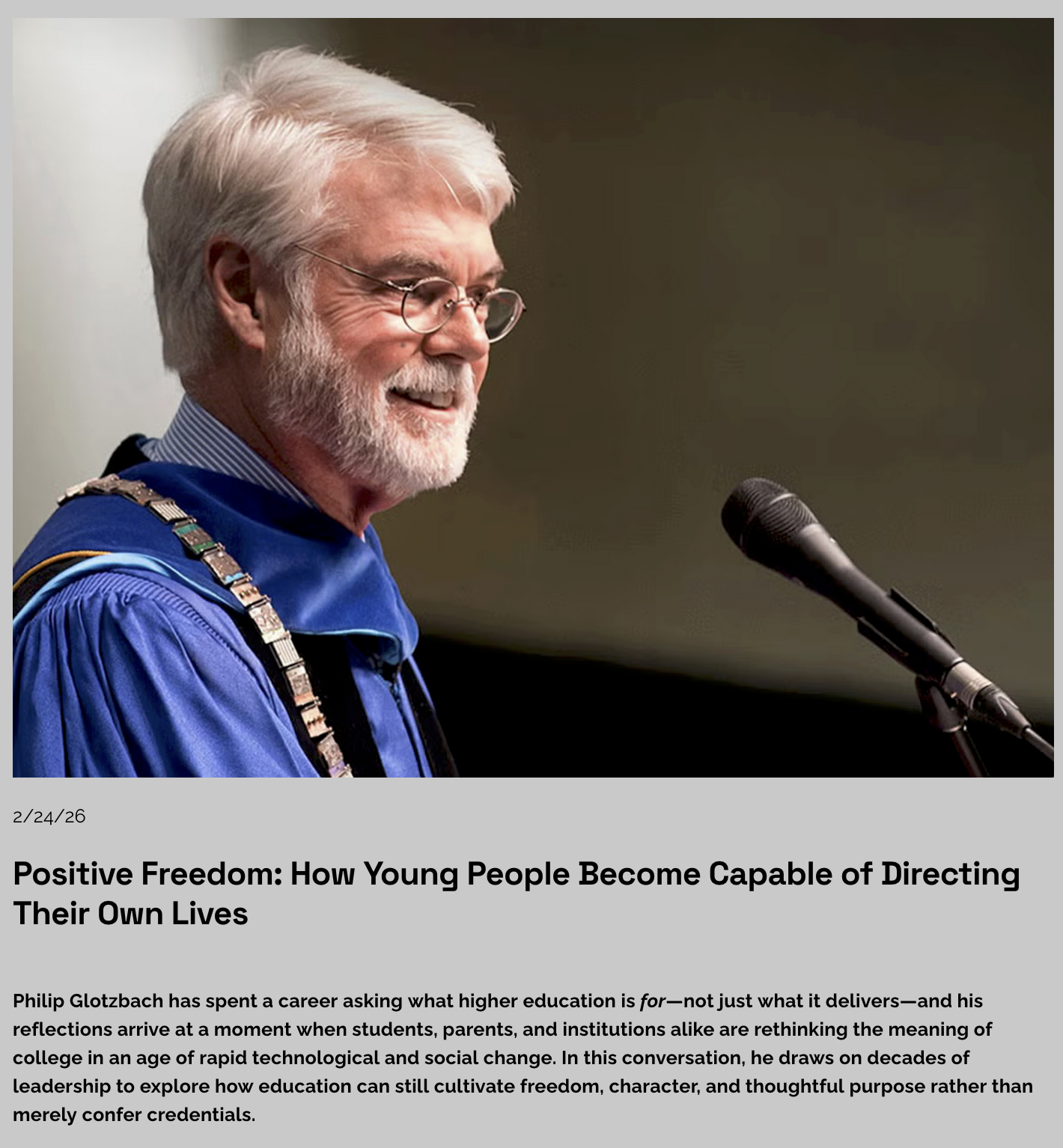
This is the Civic Conversation we published from our 90-minute conversation.
We hosted our first Civic Conversation with Philip A. Glotzbach, President Emeritus of Skidmore Collegehosted, in Zoom in February. Our focus was the meaning of freedom in higher education and civic life.
The discussion ran for ninety minutes. Under the old model, that might have produced a single article.
Instead, using NotebookLM and the Smartacus workflow, it became the raw material for a growing ecosystem of civic media.
With Glotzbach’s signoff, we have already published this.
But that article represents only the first pass through the system. The same source material can yield many more forms—each reaching a different audience, each emphasizing a different dimension of the same ideas.
NotebookLM has made this possible by giving writers a new toolbox. It allows us to ingest transcripts, background documents, and contextual sources into a structured knowledge environment. Within that environment, we can surface themes, extract key passages, test narrative angles, and draft new forms of content while keeping the expert’s voice intact.
Instead of starting from a blank page, the writer begins with a mapped intellectual landscape.
The result is not faster writing alone. It is deeper listening.
Mining Expertise, Not Replacing It
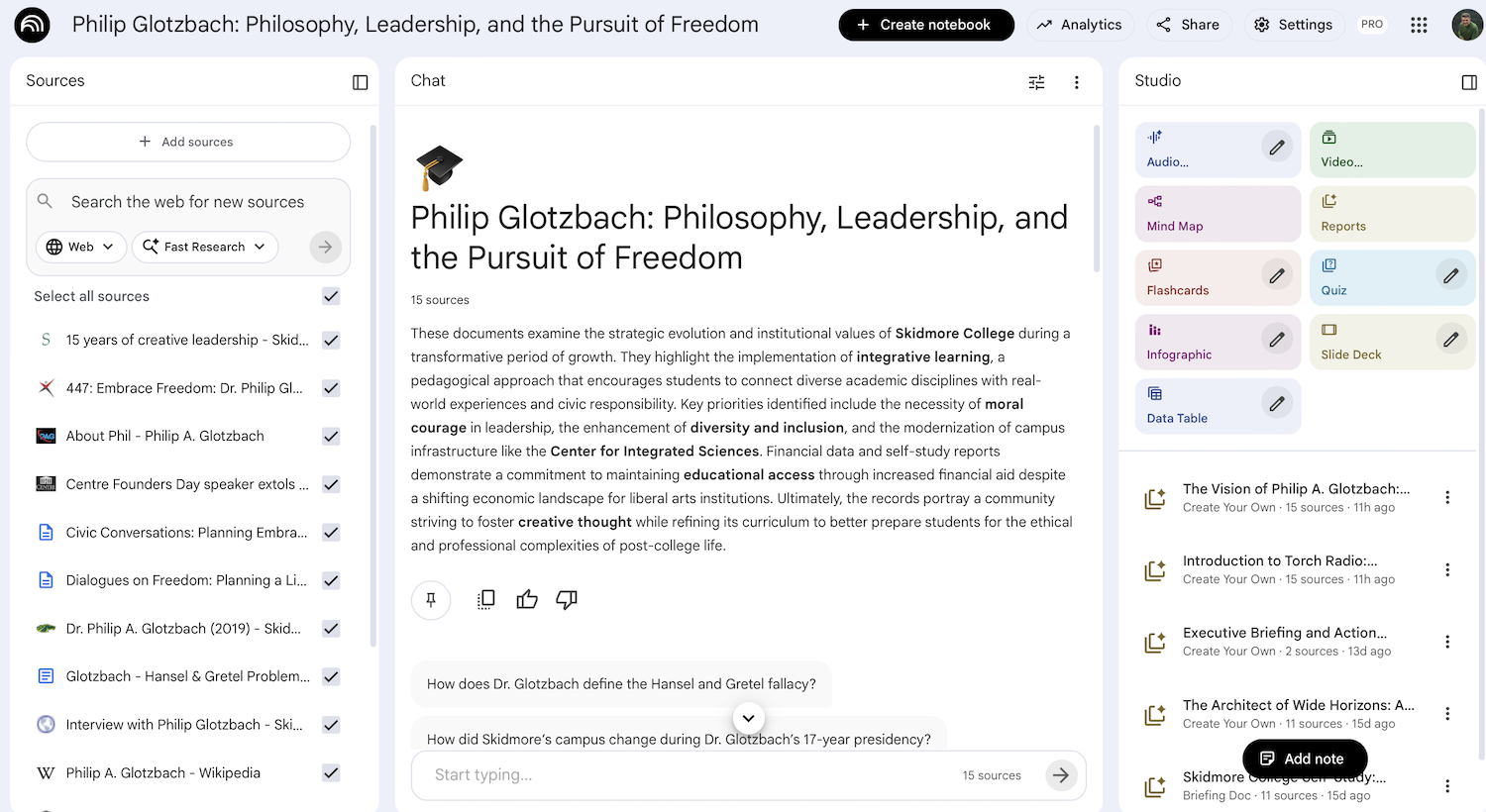
We’ve created a “Philip Glotzbach chatbot” in NotebookLM that enables us to “mine” his knowledge in any way we wish. It essentially speaks on his behalf in any form and at any length we want.
The Smartacus Story Accelerator does not treat AI as an author. It treats AI as a research partner and structural assistant.
Its purpose is to help us mine expertise, not automate it.
From our single conversation with Glotzbach and our aggregation of 18 additional sources in NotebookLM, we are developing for Glotzbach’s review and amendment in our Basecamp workspace:
• A 2,000-word profile written in the style of The New York Times Magazine
• A 2000-word portrait of Skidmore College under Glotzbach’s leadership
• A chronology of Glotzbach’s life and intellectual development
• A Positive Freedom podcast (to come)
We are moving from a world in which expertise is captured in a single definitive article to one in which it becomes a knowledge platform—capable of generating multiple formats, audiences, and uses.
A New Form of Civic Journalism
The Smartacus Story Accelerator is designed to make local intellectual life visible, shareable, and participatory. It transforms expert conversations into assets that can circulate through newsletters, podcasts, classrooms, walking tours, and community discussions.
In this sense, the Accelerator revives something that once existed naturally in small towns and colleges: the idea that knowledge should not sit in silos but move through the public square.
What AI changes is scale and speed.
Instead of one article summarizing an event, we can now produce a network of outputs—each reinforcing the others, each inviting new audiences into the conversation.
This is what we mean by AI-enabled civic journalism: journalism not merely as reporting, but as the structured circulation of public thought.